




Are website carbon calculators misleading?
Spoiler alert, the short answer is “yes, they definitely are”!




I want to start by saying that the rise in focus on digital sustainability is a welcome movement and at Pixeled Eggs, we’ve been amongst the organisations championing the sustainable web over the last few years. Also, I have no doubt that the developers behind creating the various different website carbon calculators are well-intentioned and conscientious people who care deeply about the environmental impact of the products that they create.
We live in an increasingly connected world, and acknowledging and addressing the environmental impact of our online presence, from server farms to end-user devices, is a necessary step toward a greener future. However, calculating the carbon footprint of a website, given the messy reality of global digital emissions, is basically an impossible task.
The illusion of accuracy:
Why calculation is impossible
The methodologies used on online carbon calculators are fundamentally reductive and, ultimately, misleading. They offer a definitive rating for what is, by its very nature, an impossible equation to solve accurately.
The internet’s energy usage is not a simple, measurable metric. To truly calculate the carbon footprint of a website, you would need to account for a vast, dynamic array of variables, many of which are completely invisible to the calculator:
- The power grid mix: The most critical unknown is the electricity source. Hosting your website on a server using renewable energy is the single biggest change you can make to lower its carbon footprint. A website hosted on a server powered by 100% solar energy has a negligible carbon footprint, regardless of its size. A site hosted in a location reliant on coal has a high footprint (I realise I’m stating the obvious here!). While it is often technically possible to identify a primary host, most modern websites run on complex infrastructure. Data is served from multiple Content Delivery Networks (CDNs) and third-party APIs across the globe, making it practically impossible to trace the precise energy mix and usage of every single service contributing to a page load.
- Network infrastructure: Data is bounced across a complex network of routers, switches, and cables, each consuming power. The energy consumption depends on the route the data takes, which changes constantly.
- Data centre efficiency (PUE): Data centres are massive energy consumers. Their efficiency is measured using Power Usage Effectiveness (PUE). While these are often published, they can vary greatly depending on power needs at any particular point (lighting, cooling, etc) and a calculator cannot possibly know the PUE of the specific data centre hosting your website at the moment of calculation.
- Hardware and lifespan: The energy used is shared across a huge number of devices including servers, user devices (laptops, phones), and network equipment across the world. Calculating the carbon emissions including the embodied carbon of manufacturing these devices (amortised over their lifespan) is far beyond the scope of a simple web scan.
- Caches and local storage: A user who has visited your site before will load many assets from their local cache, consuming significantly less energy. A calculator cannot account for this efficiency and variance.
- Websites have many pages: Most carbon calculators test one page at a time. If you test different pages on the same website, you will get wildly different results. Which badge do you choose to add to your site? The page that got a B or the one that got an F rating!
I’ve been thinking about all of this ever since reading the BBC article, “Does what you scroll burn coal? Mythbusting energy consumption on the web” earlier this year and unfortunately the idea that a simple tool can grade a website’s carbon footprint based on page weight or data transfer is a myth. The reality is that these tools rely on broad estimations and averages, which are riddled with holes and fail to capture the true complexity of the infrastructure.
When people accept a calculator’s score as gospel, they are being misled into believing they have achieved a specific level of sustainability, distracting them from the far more impactful variables they cannot control.
Beyond efficient code:
The “AI Emissions Monster”
If the calculation of a simple website’s energy consumption is complex, the wider digital sustainability conversation demands a drastic shift in focus.
For years, the industry has focused on “tech-only” solutions, minifying code, optimising images, not auto-playing videos, reducing HTTP requests, etc. While these are necessary steps, they pale into insignificance when considering the emerging landscape of digital emissions.
The use of Artificial Intelligence for training large language and foundation models introduces a computational energy demand that dwarfs the power consumed by even the heaviest traditional websites. Electricity consumption of data centres has doubled in the last five years and research by organisations such as International Energy Agency (IEA), MIT, and various academic studies, has shown that the energy required to train major AI models can be staggering, potentially consuming as much energy annually as entire countries.
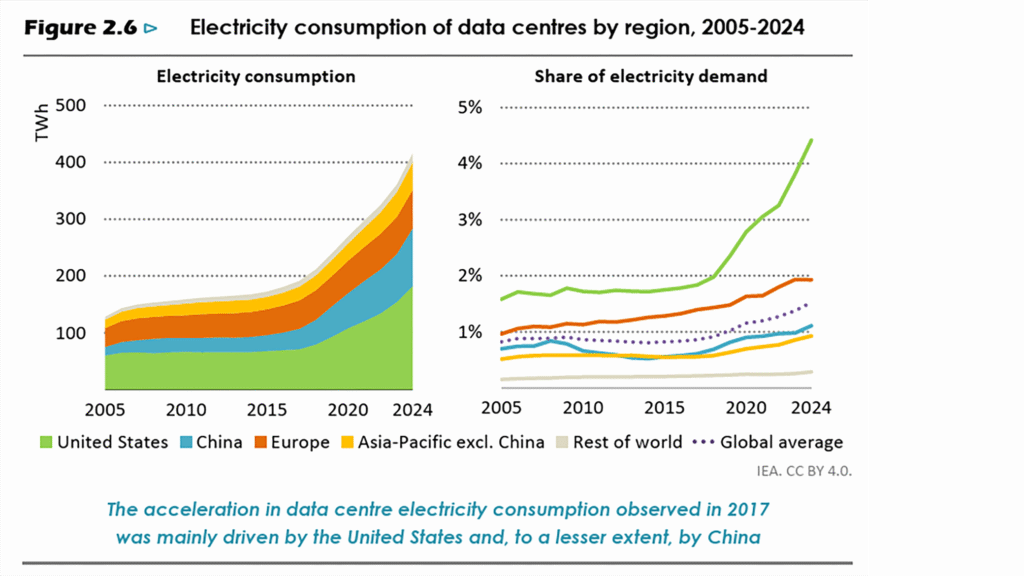
If our primary focus remains on shaving a few kilobytes off a web page while the largest corporations are building enormous, power-hungry AI infrastructure, we are missing the point entirely. This is why the conversation must move beyond code optimisation and incorporate systemic change.
We must demand accountability and transparency from the largest digital players and shift the burden of responsibility from individual developers to the systems that govern them. We need legislation in digital sustainability mandating the use of renewable energy sources for data centres, setting transparency standards for PUE, and regulating the immense energy use of AI training and deployment.
With so much of the infrastructure we depend on being based in the USA, which, along with companies like Amazon (AWS) is basically turning its backs on renewable energy, the pressure for this accountability needs a global movement.
Do the right thing, skip the grade!
None of this is to say that building lighter, more efficient websites is pointless. Quite the opposite! A lighter-weight website is almost always a better performing website and we must all do whatever is within our power, however small it seems.
Following sustainability best practices results in a faster, more user-friendly experience, which in turn reduces the necessary energy and processing power on the user’s device. Sustainable code and high performance are two sides of the same coin.
However, the act of calculating and grading a website with a reductive tool is unhelpful and potentially counterproductive.
Conclusion:
Campaign for change, not a score
The path to true digital sustainability requires honesty. We must acknowledge that website carbon calculators provide an illusion of accuracy that distracts from the root causes of digital emissions.
Instead of chasing a score, our focus should be two-fold:
- Follow best practices: Build fast, lightweight, and efficient websites that prioritise the user experience, accessibility and inclusivity that inherently reduce energy consumption.
- Campaign for systemic change: Direct our collective energy toward demanding mandatory legislation for digital sustainability. We must hold data centre operators, network providers, and large AI firms accountable for their energy sourcing and efficiency.
Start with choosing the right hosting partner and a web partner that cares about people and planet (the B Corp Directory is a good place to start). But ultimately, while data consumption giants like Meta, TikTok and AI continue to accelerate global energy demand, the only path to genuinely decarbonising the entire digital ecosystem is through mandatory systemic change.