




Our Digital Maturity Framework
We recognise that digital maturity is not a single “score” or a letter grade; it is a complex ecosystem of technical health, user experience, and strategic authority.




A strategic methodology for growth
In 2020, in partnership with BIMA, we conducted one of the UK’s most comprehensive audits of digital performance within the third sector. Today, we have evolved that research into a universal Digital Maturity Framework. This framework considers today’s advanced digital landscape and is designed to benchmark any website against the highest industry standards, providing a clear, phased roadmap to move from “Foundational” presence to “Optimised” market leadership.
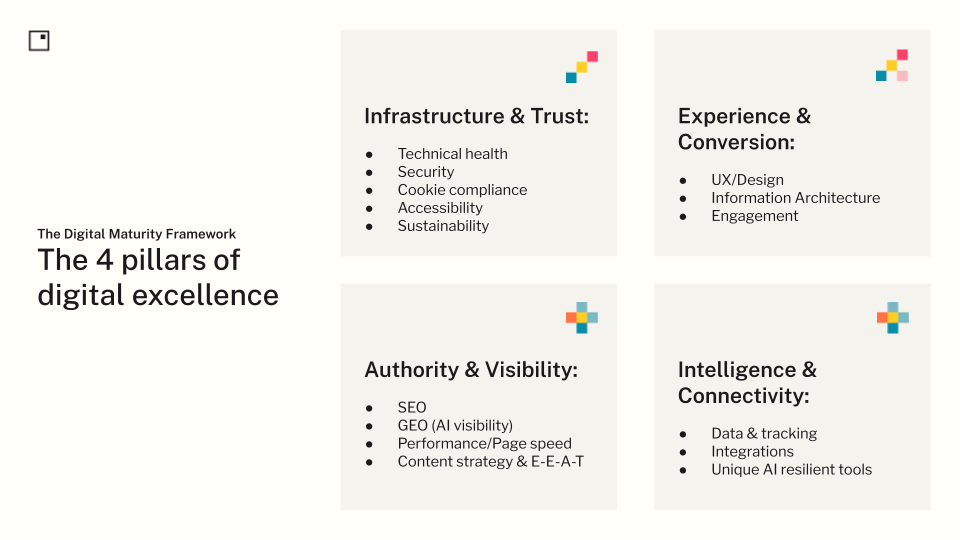
Our methodology moves beyond subjective opinions by using a Multi-Lens Audit to define a platform’s maturity across four strategic pillars.
“If you can’t measure it, you can’t improve it.”
The Methodology: How we measure
To ensure our roadmap is both robust and actionable, every element of your digital presence is evaluated through three distinct lenses:
- The Data Lens: We extract raw performance data using industry-standard tools (GA4, Lighthouse, Google Search Console, Microsoft Clarity, Wave, security scanners, etc). These are the ‘fixed’ metrics that provide the technical foundation of our report.
- The Heuristic Lens: Our experts conduct a structured evaluation against established UX, Accessibility, and EEAT (Trust) principles. This ensures the site is not just “fast,” but functional and authoritative.
- The Strategic Lens: This is the most critical phase. We acknowledge that digital excellence is contextual. A high-performing e-commerce site has different requirements than a lead-generation platform, a trust-building charity website or a brand-heavy brochure site. This lens accounts for the nuances that a simple automated scan will always miss.
The Maturity Stages
Instead of a grade, we identify which “Stage” each pillar currently occupies. This creates a overall maturity profile that highlights your unique strengths and weaknesses.
Stage 1: Foundational (Reactive)
At this stage, the platform is often a brand liability. It likely suffers from high technical debt, security vulnerabilities, or significant friction in the user journey. The primary goal is Stabilisation and risk mitigation.
Stage 2: Functional (Stable)
The site is secure, mobile-friendly, and performing its core duties. It is “active,” but lacks a competitive edge. It is a passive asset that generates results but lacks the strategic depth to scale. The goal is Enhancement of the user journey.
Stage 3: Performing (Competitive)
The platform is a primary engine for growth. It is data-validated, strategy-led, and passing all modern performance vitals. You are leveraging data to make informed decisions. The goal is Ambitious Optimisation and market capture.
Stage 4: Optimised (Leadership)
The site represents the “Gold Standard” in its sector. It is frictionless, sustainable, and optimised for AI-first search. At this elite stage, the brand is defining market trends rather than responding to them. The goal is Innovation and Future-Proofing.
Conclusion
A website is a living asset, and a single “A through F” grade can be misleading. A site may have Level 4 Security but Level 1 Content Strategy. Our framework is designed to show the balance of your digital health. We identify the specific critical dependencies, the areas where a weakness in one pillar (like slow load times) is actively sabotaging a strength in another (like great content).
This nuanced approach ensures that your roadmap focuses on the actions that will drive the greatest measurable impact for your specific business.
Photo by Towfiqu barbhuiya on Unsplash